Buying a property in Nice
for investment
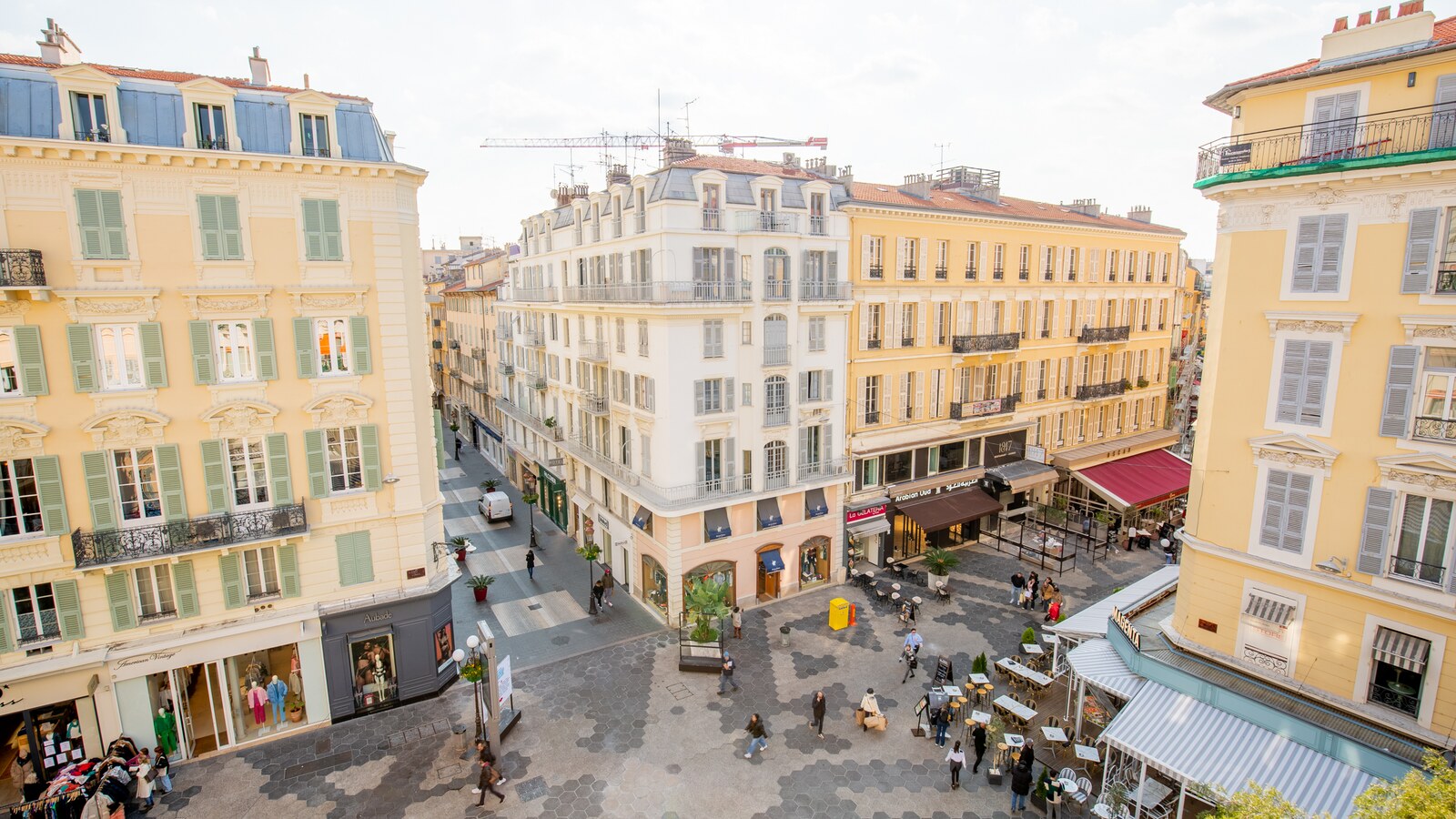
This guide is divided into three parts: "Why buy in Nice?", "Where to buy in Nice?", and "What to buy in Nice?"
We list some general reasons in our guide to Nice, but in this section we will concentrate on the financial aspects. Why Nice instead of anywhere else. If you are on this web page the chances are you have experienced a taste of what Nice has to offer as a tourist. As an investor you need to know about the financial underpinnings.
Why buy in Nice?
The question "Will this property make me money?" breaks down into two questions: "Will I sell it later at a profit?", which we call capital appreciation, and "Will it make me money in the mean time?", which we call the yield. We will talk about each of these as we go through the guide.
Property prices in Nice
There are three key factors that make property in Nice attractive: stability through a safe legal framework, globally distributed demand, and investment in infrastructure. We will go through each of these.
Stability
The legal framework applies to France rather than just Nice but is a vital underpinning. There are two different pieces of legislation that do the heavy lifting. There is the protection embedded into the standard sales contract, and there are the strict money lending laws.
Every sale must be done by a registered Notary, and every sale comes with a government guarantee. The buyer is protected and if there is any problem post sale then any legal action will have to be taken against the Notary rather than the new owner. Once a price has been agreed then both parties sign a pre-sales contract called the "Compromis de Vente". At this point the seller is immediately locked into the sale at that price. The buyer then has a 10-day “cooling off” period in which to decide if they wish to go ahead. This means there is no gazumping, and the seller cannot back out of the sale or renegotiate the price. By the end of the 10 days the buyer will put down a 10% deposit, held by the Notaire in a government escrow account. If you want to know more about the buying process itself then please read our guide to that on our site.
The second arm to the stability are the strict lending rules which state that your monthly repayment on your loan cannot exceed 1/3 of your net income. This is usually your salary after tax, or if self employed or your money goes through your company then it is usually an average over the past couple of years as long as there are at least three years of records. Additional income can be taken into account, such as long term or short term rentals, though these may be weighted according to their perceived risk. Current assets are not taken into account, it is purely revenue based. You have have $10m of paid off property but if you have no declared income then the French back will not lend you a single penny. If you are French resident then you can get up to a 100% loan, though in practice whether you get that depends on the economic climate, and if you are non-resident then you can get up to 85% of the purchase price. This does not include the "Notaire fees", ie government taxes, you will need to pay this on top. It does not matter where in the world you live, the law applies equally to French, EU, and rest of the world. However individual banks may have their own preferences as to which countries they are prepared to loan to residents.
Desirability
There is a local expression, "A Nice, tout se vend". In Nice, everything sells. This is a cosmopolitan city that welcomes all nationalities and it is the breadth of appeal that gives the market resilience. It is popular with the British, Irish, Americans, Italians, Germans, Swiss, Danish, Swedish, Belgians, and many other nationalities. If one nation is economically down, another is up and buying more. A well priced property in the city centre will sell in days rather than months.
Of course: location, location, location. Certain areas are more desirable than others but even within the desirable areas some are more attractive to a certain demographic than another. A younger couple may be drawn to the convenience of living in the Old Town, a more affluent and elder couple to the more residential and prestigious Musicians Quarter. We will speak more about this later.
Investment in infrastructure
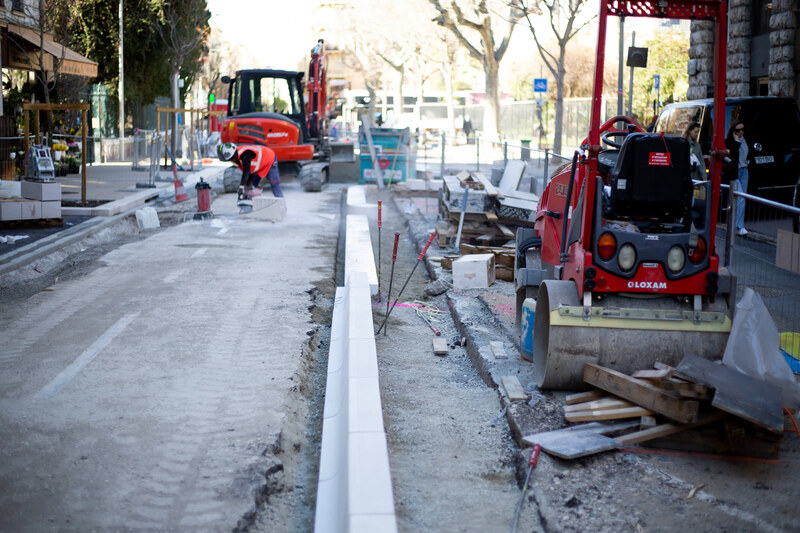
Nice is incredibly well connected. It is France’s second busiest airport city, with direct flights all over Europe and the world. It hosts the luxury airlines as well as the budget ones, with great connections to the UK, Ireland, USA, the Middle East and everywhere else. It also is connected to France's high speed rail network, as well as the main motorway network easily accesible from the city centre. Italy is half hour drive away and Nice makes a great base for exploring countries nearby and beyond, though the locals might wonder why you want to go anywhere else.
Over the past few years billions of euros have been invested into connecting all the transport types together, with the new train station built at the airport now connecting the airport (with both Terminals newly expanded), the tram, the bus services, as well as the motorway all in one place. The tram network has expanded to reach all four sides of the city, with the direct line from the airport to the city centre particularly convenient. You can arrive at the airport and jump on the tram directly outside, and be in the city centre in half an hour for €1.70 per person. Tip: if it is your first time visiting then the tram is free between Terminal 2 and Grand Arenas, and from there you can buy the €1.70 ticket if you do not want to pay the €10 from the airport itself.
Yet more grand projects are coming thick and fast. Some examples are a 40,000sqm Conference Centre near the airport, which will make it one of the largest in Europe and will be finished in 2032, and the new airport train station, which will make a spectacular welcome to Nice.
Do not be led into believing it is all about flashy projects. Others include a state-of-the-art recycling centre processing 16,000 tonnes per year generating over 200MWh of heat and electricity, starting 2027 and a water recycling plant which not only processes over 5 million gallons of water per year (twice as much as the entire population if Nice needs), filters out over 90% of microplastic, but generates 4x as much electricity as it uses. That is an excess of 67GWh. This last project is one of the ten largest ongoing in France and will cost three quarters of a billion euros, fully in operation in 2030. This is not to mention the new "Eco valley" which is almost a city within a city.
When the tram network was upgraded to include the underground line, the city decided to remove all the bus lanes and turn them into pedestrian and bicycle paths with trees and flowers lining the streets. This has led to a big increase in the quality of life in the city centre in terms of environment and noise. Soon all buses will be 100% electric. The city remains committed to planting tens of thousands more trees, and to building new parks within the city limits that are not only great for residents but have been proven to lower the local temperature within quite a large radius by several degrees. Pretty useful for a world getting more heatwaves.
The old Place Massena and Place Garibaldi used to be noisy and dirty car parks. Now they are stunning pedestrian piazzas. What is now the Coulee Verte park that runs from Place Massena alongside the Old Town used to be the city bus station, car parks, and an eyesore McDonalds. The transformation has been incredible and it seems we are just getting started. The world has woken up to the fact Nice is no longer the scruffy neighbour of a few decades ago next to Cannes and Monaco but is now the jewel of the French Riviera.
As Nice continues to grow and improve, the city continues to stick to its heritage. Everything is carefully managed and no shortcuts are allowed: preservation remains the highest priority. The photos you see from a hundred years ago will still look familiar to you walking around the streets today.
Where to buy in Nice
Property tends to fall into certain price bands. We have compiled a table below which shows where investors tend to spend their money for a given budget. It should serve as a guide for where you should be looking, though it is general rule of thumb.
| Area | below €250k | €250-€400k | €400-€600k | €600-€750k | €750-€900k | €900k above |
|---|---|---|---|---|---|---|
| Old Town | Typical budget | Typical budget | Not a typical budget | Not a typical budget | Not a typical budget | Typical budget |
| Port | Not a typical budget | Typical budget | Typical budget | Not a typical budget | Not a typical budget | Not a typical budget |
| Carre d'Argent | Not a typical budget | Typical budget | Typical budget | Typical budget | Not a typical budget | Not a typical budget |
| Carre d'Or | Not a typical budget | Typical budget | Typical budget | Typical budget | Typical budget | Typical budget |
| Musicians Quarter | Not a typical budget | Typical budget | Typical budget | Typical budget | Typical budget | Typical budget |
| Promenade | Not a typical budget | Not a typical budget | Not a typical budget | Not a typical budget | Typical budget | Typical budget |
From €200-300k people look for a pied-a-terre in the Old Town or the Carre d’Or. At the lower half it will be a small one bedroom in the Old Town around 30sqm or a studio in the Carre d’Or about 25sqm. In the top half it will be a reasonable size one bedroom around 45sqm in the Old Town or in the Carre d’Or around 30sqm. Principal obstacles from an investment viewpoint (hence the price) tend to be the apartment is not bright enough, it is too noisy, or it is on the ground or first floor. The principal obstacle for the investor is to overlook the small size (even apartments as small as 15sqm sell). Holiday makers renting this type of apartment are young and just want a place to sleep. For them location is everything. The size can be dressed with clever furnishing but the final rental price for your outlay is the key. You can get some great bargains in this price range and area but in terms of rental you also face a lot of competition.
In the €300-€400k range people tend to look for a one bedroom in the Carre d’Or with a small balcony, or a two bedroom in the Old Town. The rental demographic here is the young to mature couple. They want to be shopping or on the beach during the afternoon, but will want to spend some time in the apartment before heading out to the restaurant or bar in the Old Town or on the Zone Pietonne. A short and safe walk home is important.
From €400-600k the search is for a two bedroom in the Carre d’Or or the Musicians Quarter in an old building with a balcony or terrace. The renter will be a more mature couple or a family. The building should have character, and the trade-off is between size and original old features or a balcony large enough for a couple to dine on. Unfortunately “bourgeois” and “terrace” are contradictory, though a compromise can be found in turn of the previous century Art Deco buildings which can offer stunning looks plus an above average size balcony. You should be prioritising a beautiful building in a great location over outside space in this price range otherwise you will find yourself either sacrificing area, for instance finding yourself in the Fleurs district, or losing the charm of the building.
At €600-€750k you are expecting a two or three bedroom apartment that is really special. It will be either renovated to a high luxury standard, be over-sized by local standards in a beautiful building, or have something unique like a slice of sea view or a terrace large enough to dine out on. We sell properties in this prices range in the best areas that would not look out of place published in a glossy magazine. Again you will be in the Carre d'Or or the Musicians Quarter.
From €750-€900k is an odd price range that sites between the luxury end of the market for the city centre, and the ultra-luxury market at the top end. In practice, I find having a budget of €850,000 increases the range of properties very little over somebody with a budget of €750,000. Sometimes it works for those that want a €1m+ property but cannot find one that fits their taste and are prepared to renovate.
Between €900k and €1.2m is the ultra-luxury. The penthouse suites. The rooftop terraces. It should have something unique that at any one time there are less properties with the same feature on the market than the fingers on one hand. At this end it is more about capital appreciation than yield. Buying well in this price range is like buying pure gold. You have your pick of the properties with nearly no restrictions. It could be Promenade des Anglais, in the Musicians Quarter, something spectacular in the Old Town. Anywhere you choose. There are only a handful above this price range, and most of those are optimistically priced.
What to buy in Nice?
Honestly: a holiday home, or a place you want to eventually move in and live there. We get stories of clients buying in the UK and the USA getting over 20% returns, or buying and flipping a house for twice the price in a few years. Neither are likely in Nice. The same thing that makes buying here such a safe investment also means unusually good deals are hard to find.
I cannot think of a client that has sold at a loss in the past decade, and sometimes they get a 6-figure profit, but generally a rule of thumb is that you sell in the 3-5 year range then you will make a small profit after you take into account the 7.8% purchasing costs. Less than that then you can probably break even if you bought well and are not financially distressed. More than that and you will get a modest increase in profit for each year. You can buy and renovate to save money but it is hard to find deals, so making a healthy profit once does not mean it is easy to turn into a profession down here.
When choosing what to buy, put in safety margins. Your home in Nice should be a source of joy, not stress. For the past decade, clients tend to make a 10% gross profit on their holiday rental vs their purchase price. This does not mean is will continue. There could be an unexpected change in the law at EU level, and French national level, at Regional level locally, which could affect your ability to rent out. With climate change we are seeing freak weather events, and this can happen anywhere. What if weather damages the roof and the apartment gets flooded just before the holiday season starts? Will losing the summer affect your ability to pay the monthly loan repayments?
The great thing is that in Nice... everything sells. You can buy something which fits your financial situation comfortably, and when you are really to upgrade it will be very very easy and quick to sell.
Final thoughts
We are a real estate agency, not financial advisors, and do not have a magic crystal ball to see into the future. Over the past couple of decades, property prices have steadily increased. All the evidence we have seen does not give us any reason to believe this trend will not continue. We believe ourselves that Nice is an excellent place to invest, but this is our opinion.
Rental yields have always been very good in Nice, but anything we publish on this site can easily be out of date the moment a new law is passed. The best time to do your due diligence is after you have had an offer accepted and before you sign the Compromis de Vente. The people to ask are your real estate agent, your Notary, and the building management company called the "Syndic". The Notary can check with the latter on your behalf but you will need to explicitly ask for them to do it, it is not something they are required to do. If you find the building prohibits holiday rental and the rental income was vital to your purchasing plans then you can simply not sign the sales contract even if you have had an offer accepted. Note: just because other holiday rentals have been authorised in the same building does NOT mean yours will automatically have the right. It is up to you to check.
There are a lot of web pages with information of varying levels of accuracy, and of course this is picked up by the AI engines you might ask. If you have read this far and are now convinced buying in Nice is something for you then the best way for you to get the latest information is to simply to write me an email or give me a call. Other than arranging a time, asking me questions is not really any harder than asking your AI bot.

Expert advice for your investment
This is only a guide. For real expert advice please contact Phillip Temple using the button below. He will be happy to give you a free consultation and set you on the path to a successful purchase in Nice.