Making a written offer
This carries no legal commitment on the part of the buyer. However it will block off the property for you and take it off the market so you should do this as quickly as possible. It is a general rule that the first written offer is treated first, even above a higher one made straight after. The seller can either accept, refuse, or come back with a counter offer. It is a good idea not too make the offer so low that it is simply refused, you really want to get a counter-offer.
Once you have the price agreed then your agent will get the listing agent to counter-sign it and send it back. The negotiations can last a few hours or a few days depending on how far apart the parties are and how many sellers need to agree. The offer is only valid if all the sellers listed on the title deeds counter-sign your offer.
The things that are important to include on your written offer. The correct address of the property you are making an offer on. The date the offer is being made. The amount you are offering, after checking agency fees are at the charge of the seller, otherwise the amount plus the fee you are paying to your agent. Finally whether this is a cash offer or it is subject to obtaining a bank loan. The last clause is only if you are getting a loan from a French bank, you cannot use it if you are getting a loan outside of France.
Once a price has been accepted then we move onto the Compromis de Vente. At this point the sale becomes legally binding for the seller, and the buyer starts engaging responsibilities.
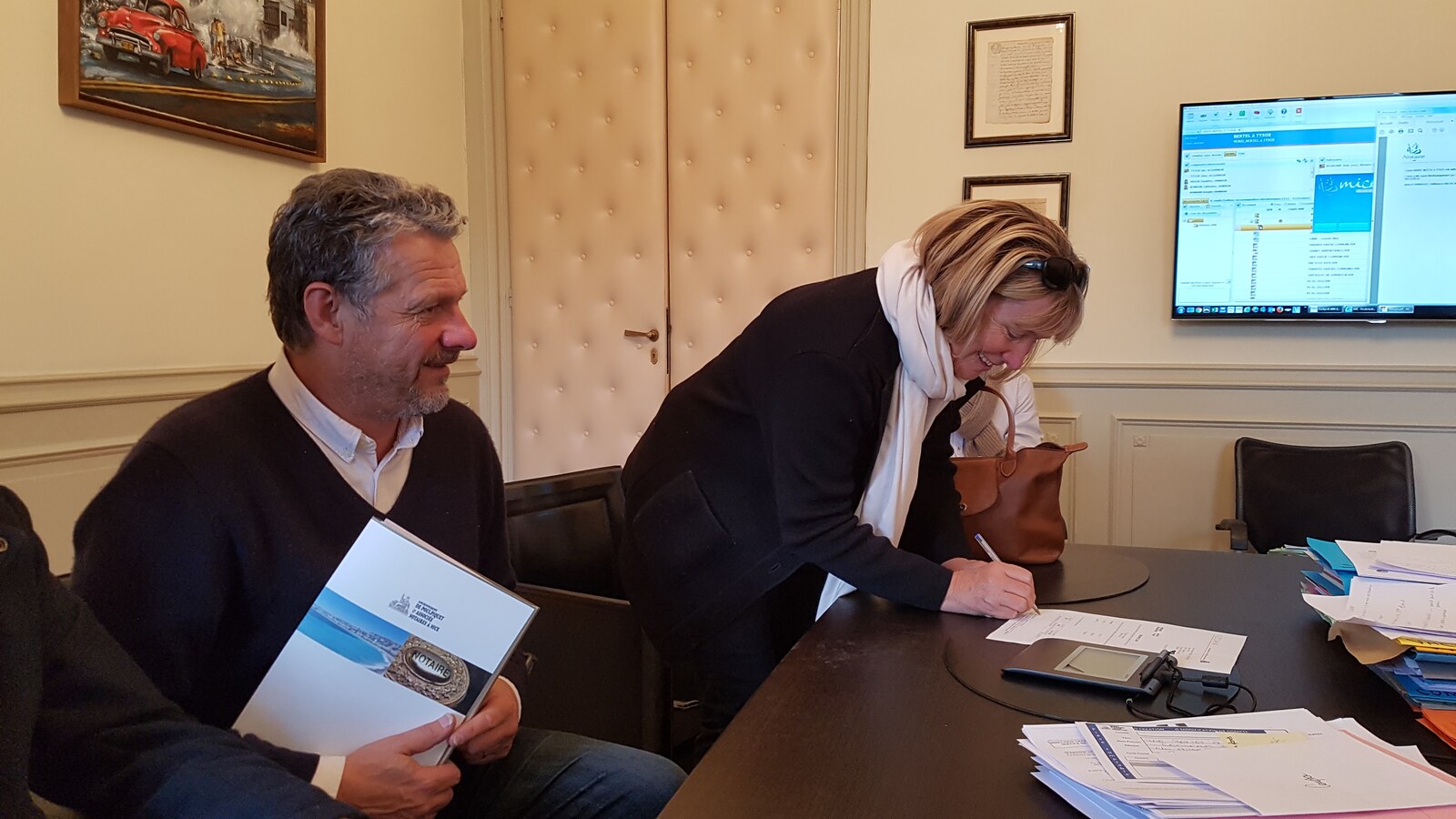
Signing a Compromis de Vente
The Compromis de Vente is the key legal contract around which all sales revolve. This document is identical whether buying a small studio in the Old Town or a multi-million euro penthouse on the beach front. Today it is usually filled in by the Notaire but it is equally valid if done by an estate agent or between two individuals. It is this uniformity which makes the process so simple and safe.
Before you sign the Compromis de Vente, you will receive a copy of all the legally required sales pack. This includes:
- certificates provided by an insured expert, which include the officially measured size of the property, the energy efficiency rating, and tests for lead, asbestos, and termites.
- a copy of the last three years of Annual General Meeting (AGM) minutes where all decisions about the building are made. It will show any recent building works done, any upcoming works to be voted on, and any issues raised by any of the residents.
- the financial health of the building including debts by owners and if the building owes any suppliers.
- a copy of the last council tax bill and the last quarterly building charges
If you have a good agent then they will arrange a time to go through all the documents with you so that you understand them all, as well as flag up any potential issues or problems. Your Notaire is obliged to go through all the documents with you and ensure that you understand them before allowing you to sign. However remember they do not know the apartment and they are there to protect you from a legal standpoint. It is up to your estate agent to bring up issues from a real estate perspective and make sure the Notaire includes clauses to protect you.
You are free to choose any Notaire to represent you. It is not uncommon for each party to have their own Notaire, this costs exactly the same, though often they both agree on one to make the transaction faster. Your agent should be able to recommend a good Notaire. Remember that though the Notaire is there to protect your interests, they are not there to represent your interests. The Notaire represents the government and are expected to act like an impartial referee.
Paying a 10% deposit
The buyer is required to put down a deposit to make the contract valid. It is important to know the difference between the penalty for breaking the contract and the deposit place to make the contract valid.
There is an identical 10% penalty for either side deliberately breaking the contract. For the seller, that amount is held against the property and they will not be allowed to sell it again until that debt is paid. For the buyer, they are expected to pay to the Notaire a deposit as a show of good faith which might be used as a final recourse if the contract is broken.
Originally, the buyer would be expected to turn up to the signing with a certified bankers cheque for the full 10%. In this digital age things are more relaxed. Most Notaires will accept a bank transfer, which must be wired from an account in the name of the buyers, within 10 days of signing. Though often sellers insist on the deposit being 10%, there are also cases they can be persuaded to reduce this as low as 5%.
The deposit is wired to your Notaire and is held in a government controlled escrow account. This is either returned if the sale does not go through, unless you deliberately broke the contract, or is then deducted from the final sale balance at closing.
The 10 day "cooling off" period
By law you have a ten day “cooling off” period in which you can change your mind and cancel the sale without penalty. You do not need a reason or have to provide an explanation for cancelling. If you have already paid your deposit then your Notaire will simply transfer it back to you. The ten days begin the day after you sign for the registered delivery letter containing a copy of the Compromis de Vente signed by both parties along with a notification of your cooling off rights titled “Loi SRU”. To cancel, simply send a registered delivery letter to the estate agent and/or the Notaire telling him you no longer wish to go through with the sale.
The seller does not get a cooling off period. The moment they sign then they are locked in. They cannot change their mind or change the price.
Warning: if you are signing at the same time as the seller, or if the seller has signed first and you are counter-signing (which is unusual), then it is possible the Notaire will ask you to sign the “Loi SRU” directly as “remis en main propre”. This means rather than posting it to you, you are signing a witnessed statement that the documents have been handed to you in person. In this instance, the ten day cooling off period starts the next day.
Warning: these are 10 calendar days, including weekends and bank holidays. If the 10th day falls on a Sunday or holiday and the post office is not working, it is your responsibility to get it into the post before then.
Obtaining a mortgage
There are two methods of stating how the purchase will be financed: requiring a bank loan or not requiring one.
You have the right to apply for a French mortgage, and if you fail to get one then your deposit is returned and the sale falls through. When you sign the Compromis de Vente you will have to fill in the mortgage details, ie amount to be borrowed, number of years repayment, expected interest rate, and banks you intend to apply to. You commit to start applying for the mortgage within two weeks and obtaining the offer in around a month. If the bank is causing delays beyond the deadline do not panic, the Notaire is able to check this is the case with the bank and as arbitrator will not impose any penalty on you.
It is important you start applying in a timely manner because once you finally get a formal mortgage offer then legally you must wait 11 days before you are allowed to sign it and post it back accepting the mortgage.
For the escape clause to apply and your deposit to be returned, you must have genuine application refusals from the bank. It cannot be a letter from your friendly bank manager saying he does not think you are suitable for a mortgage.
Unlike the ten day cooling off period, which is a right you cannot waive, you can put in the Compromis de Vente that you do not require a mortgage. This involves hand-copying a rather long paragraph assenting to waive this right. Why would you want to do this? Because given a choice of two similar offers, the seller will prefer to accept the one without the dependency on a mortgage. The reason for this is that after ten days he knows the sale has gone through and can safely purchase a new place to live. Otherwise a buyer and/or bank could mess the seller around for one or two months before the whole thing falls through with the seller back to square one and a lot of wasted time. If the seller is desperate to sell then not requiring a mortgage can in fact be a powerful negotiating tool and get you a discount on the price.
Signing the final deeds
Prior to the signing, the Notaire will send you a complete breakdown of costs and a balance that needs to be paid. This must clear into the Notaire’s account by the day of the signing. If you are using a currency broker then they can transfer directly to the Notaire. You do not need a French bank account.
You must be present, or have signed over power of attorney to your Notaire, for the day the deeds are signed. You can still be present via video link for the signing even if you have signed over power of attorney. If you are not fluent in French then nearly all Notaires will insist on a Town Hall registered translator for the closing even if they speak English and did not require a translator for the signing of the Compromis. This is for their own legal protection.
All copies of the keys will be handed over as soon as the papers are signed. If you are not present you can nominate your estate agent to look after them until you next return. On this day the apartment must be empty: both of anyone living there and any furniture both parties have not agreed should be left there. Any included cellar must also be empty. If there is still a tenant then the Notaire can impose hefty fines on the seller. If it is not cleaned out then the Notaire will withhold a sum of money from the seller to ensure it does get cleaned correctly. If you are not present for the closing then your agent can give you a video tour shortly before so that you can verify the state of the apartment before signing.
Note: you are legally obliged to have household insurance in place upon taking ownership. You can do this up to and including the day of signing.
Transfer of utilities
The estate agent will help transfer of utilities for you, including taking meter readings if necessary. The three utilities you need are electricity, water and Internet.
The most urgent is the electricity. Up until 2022 your estate agent could actually do the transfer for you but now the EDF insists it must be the owner that calls or sends email. Fortunately they have dedicated English speaking staff to assist you so it should be quick and easy. You need the meter number, called the "PRM". If the meter box is green then it is the new "Linky" which is connected in real time, otherwise you will need to take the number of "kWH". This may be divided into "Pleine" (peak) and "Creuze" (off-peak) if the previous owner had that option to subscribe to it. You will need these numbers plus a valid IBAN, and you are good to go.
Water is usually metered by your building management company and added itemised onto your quarterly "Syndic" bill. If not then the listing agent will provide a water bill from the last quarter before the sale so you have all the contact details to make the transfer. If this is the case then you need to take the water meter reading and have that ready.
All of Nice is getting fibre optic Internet access so if your building does not already have it then it will soon get it. If your building has fibre access but your apartment does not then the telecom company will come and install the fibre box for you. Ordering Internet is done via the web site and the box will be posted to you. Simply plug in the box and it will start working. The providers we recommend are Bouygues and Free.
As regards your building management fees and any tax bills from the local government, the Notaire takes care of providing your contact details directly to them. They will be in touch when there is a bill that needs paying.
